


I am writing this blog entry from inside our classroom Nosy Cao, sitting at the desk below the window which opens onto a view of Half Moon Beach. From this angle, I can observe at least seven distinguishable shades of aquamarine in the ocean below me, and there’s not a cloud in the sky. There are half a dozen pirogues out on the water, their white sails reflecting bright and radiant in this morning’s sunshine.
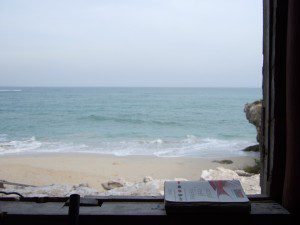
View from Nosy Cao, the classroom
Unfortunately I’ve got a bit of a head cold at the moment and thus have not been able to equalize for the last couple days. However, instead of continuing to feel sorry for myself, wallowing in the sorrows of being land-bound, I thought this would be a better use of my time. Already the “new” set of volunteers (all four of us) have been here nearly three weeks. The three of us who were not yet Advanced Open Water certified have now finished that course (yay!) and we have started doing some Point Intercept Transects (P.I.T.s) as well. We’ve almost finished learning our fish species (they were so much easier to recognize once I had actually seen them swimming around), and hopefully we’ll be moving on to fish belts next week.
The weather here has been interesting. I was expecting cooler days (mid-20s) since it is the winter season, but already we’ve had a couple pretty wet, rainy and windy bouts as well. On our first day off, only a week into our expedition, we took a group of pirogues over to the island Nosy Hao for the day. The weather was slightly overcast when we left, but by midday the sky had really gotten grey and there was thunder and lightening in the distance. This quickly evolved into a full out rainstorm right over the island, and we could no longer see the mainland. We tried to shelter ourselves from the pounding of the cold rain under the pirogue sails but it was a pretty tight squeeze and ultimately a limited success. A few of us decided to take our chances in the ocean instead, so we threw off our already soaked clothes and ran into the water. Once in the sea, it was actually quite a surreal experience: floating in gorgeous bright blue-green water with black skies above, and heavy raindrops shooting furiously down at us, before bouncing back out like highland dancers. Naturally we made the most of the stormy waves and we swam and jumped like little kids in the world’s biggest bathtub. Once the rain settled enough to attempt a return trip, we quickly loaded the pirogues and made for Andavadoaka. The trip took a long time because of the wind, waves, and rain, but it was an experience I will not soon forget. The storm itself ended up lasting for at least another two days, during which we had no power and part of the well pump was damaged. So we didn’t have running water for about ten days after that either, but that wasn’t too big a deal once we got used to it. (The pump was fixed a couple days ago and everything is back to normal now).
So far I have really enjoyed my time here, and I’m thrilled to be surrounded by marine life everyday. Even when not diving, it’s been nice to go walk amongst the tidal pools or snorkel in the seagrass beds to see what’s hiding and surviving amongst their flora. That said, I’m really looking forward to being over this cold so I can get back in the sea and help with more science dives. The corals and fish are so beautiful and I love seeing them interact and behave in their natural habitat. About a week ago we saw a HUGE southern stingray at the Lovobe site. It must have been over five feet long (without barb and tail) and nearly four feet wide. It didn’t seem too concerned about us and we were able to watch it for a while before it rose up off the sand (similar to a fighter jet) and swam off gracefully. Although that ray was amazing, my favourite fish experience thus far was a few days ago during my underwater benthic test. Thinking that I was a manatee, or at least a larger fish, a little golden trevally followed me for the whole dive. Sam (my boyfriend/ dive buddy) told me that it hovered just beside my bright yellow scuba tank for most of the time, although I was lucky enough to see it pop up twice near my BCD. I’m not sure what specific species it thought I was, but either way, I must have looked the part of strong and fearless protector. I’m sure I will have many more enjoyable and memorable aquatic experiences, but I was very grateful for that one. As silly as it may sound, that little fish’s behaviour made me feel like I was welcome here. It made me feel like I was actually a part of the reef ecosystem that I am lucky enough to visit on a daily basis, and I was more than happy to share my dive with such an adorable local. And I’m pretty certain that it helped me pass my test too!

hey dear
Just to tell you that I loved reading your blog… So well writtne so lively, it was as if I had been with you and your golden trevally in the water, and in the pirogue under the storm.
I visit Blue Ventures website almost everyday because I have a son currently in a BV expedition in Belize. We cannot communicate because the camp site in Belize is so remote.. So, while sitting at my desk at the World Bank in Washington DC, I sometimes take a few minutes to read a couple of info on BV website. It’s my way to stay connected with what my son must be experiencing. After reading your blog, I am sure that he must have a terrific experience as well and I am so excited fro him and for all of you. People like you are the new pionners of this planet and hopefully will save some beautiful places from so many human-made disasters by our older generation.
best and hope you continue to enjoy as much
Veronique
PS: if you have time to answer, how many expeditionners like you are currently on the camp site. Your note seems to indicate you are only 4 or 5. I though there were many more in Madagascar.